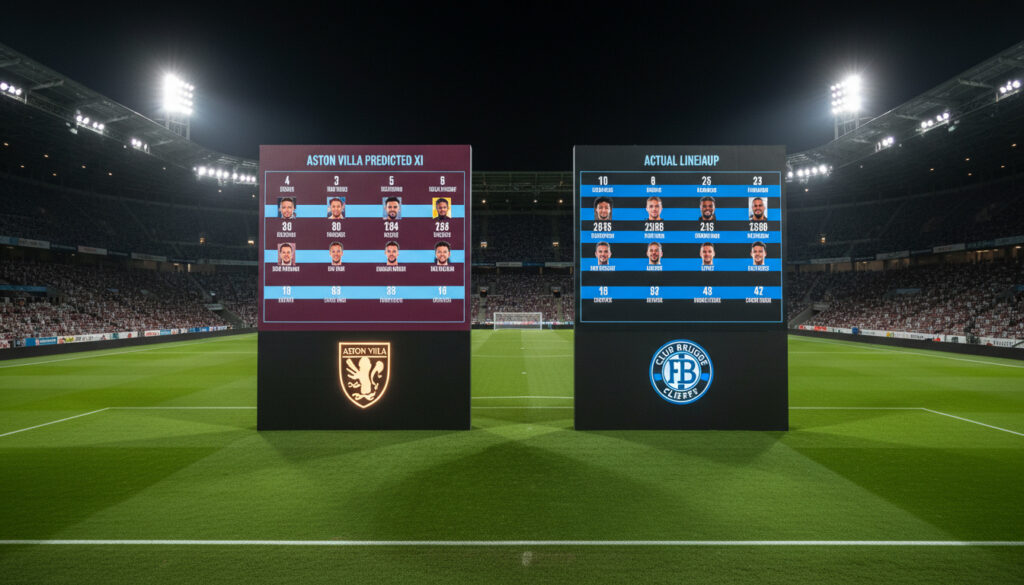
Aston Villa vs Club Brugge Lineups – Predicted vs Actual XIs
Aston Villa secured a commanding 3-0 victory over Club Brugge at Villa Park on March 12, 2025, completing a 6-1 aggregate triumph in the UEFA Champions League Round of 16. The result confirmed Villa’s place in the quarter-finals for the first time since their 2019-20 debut campaign, where they will face Paris Saint-Germain.
The Midlands club entered the second leg holding a comfortable 3-1 advantage from the first meeting in Bruges on March 4. Manager Unai Emery balanced rotation with continuity, naming a starting lineup that aligned closely with pre-match predictions while keeping key impact substitutes available for the second period.
Marco Asensio proved the decisive figure, scoring twice after entering as a halftime substitute to earn Player of the Match honors. The display showcased Villa’s attacking depth, though winter acquisitions Donyell Malen and Andres Garcia were notably absent from the knockout squad registration.
What Were the Predicted Lineups for Aston Villa vs Club Brugge?
Aston Villa
3-1 aggregate lead
Club Brugge
Need 2+ goals to force extra time
Villa Park, Birmingham
UEFA Champions League
Round of 16 Second Leg
Key Tactical Insights
- Both managers favored 4-2-3-1 formations, prioritizing midfield control and wide attacking threats
- Aston Villa’s predicted XI included Ollie Watkins as the focal point, supported by Marcus Rashford and Morgan Rogers in wide areas
- Club Brugge relied on Ferran Jutgla’s scoring form, with the striker having netted six goals in his previous seven appearances
- The right-back position generated pre-match debate, with Axel Disasi featuring in some forecasts before Matty Cash secured the start
- Chemsdine Talbi entered the match having scored three goals in his last three European outings
- Winter signing Pau Torres was declared fit following an ankle injury, competing with Tyrone Mings for the left-sided center-back role
- Odds-makers installed Villa as -160 favorites to advance, reflecting their two-goal cushion
Predicted vs Actual Lineups
| Position | Aston Villa Predicted | Aston Villa Actual | Club Brugge Predicted | Club Brugge Actual |
|---|---|---|---|---|
| GK | Martinez | Martinez | Mignolet | Mignolet |
| RB | Disasi/Cash | Cash | Sabbe | Sabbe |
| CB | Konsa | Konsa | Ordonez/Mechele | Ordonez |
| CB | Mings/Torres | Mings | Mechele | Mechele |
| LB | Digne/Maatsen | Maatsen/Digne | De Cuyper | De Cuyper |
| DM | Kamara | Kamara | Onyedika | Onyedika |
| CM | Tielemans | Tielemans | Jashari | Jashari |
| RW | McGinn/Rogers | Rogers | Talbi | Talbi |
| AM | Rogers | McGinn | Vanaken | Vanaken |
| LW | Rashford/Asensio | Rashford | Tzolis | Tzolis |
| ST | Watkins | Watkins | Jutgla | Jutgla |
Sources: Sports Mole, UEFA Official Match Centre
What Was the Latest Aston Villa Team News?
Aston Villa approached the second leg without major injury concerns, creating selection dilemmas across the defensive line and attacking midfield. The return of Pau Torres from an ankle issue provided Emery with additional tactical flexibility, though the Spain international began the fixture among the substitutes.
Defensive Selection Decisions
Tyrone Mings retained his starting position alongside Ezri Konsa in central defense, with Martinez behind them as expected. The right-back slot saw Matty Cash preferred over Axel Disasi, while Ian Maatsen operated on the left flank in a fluid system that allowed rotations with Lucas Digne during the match.
Winter acquisitions Donyell Malen and Andres Garcia were omitted from Villa’s knockout stage squad submission, limiting Emery’s attacking options despite their recent arrivals. Pau Torres returned to full training following ankle rehabilitation and entered the match as a 66th-minute substitute.
Midfield and Attack Availability
Youri Tielemans and Boubacar Kamara formed the double pivot as anticipated, providing defensive screening for the back four. The attacking midfield trio of Morgan Rogers, John McGinn, and Marcus Rashford supported Ollie Watkins, though Emery held Marco Asensio and Leon Bailey in reserve for strategic second-half introductions.
Post-match reports indicated Jadon Sancho would remain unavailable through illness until mid-October 2025, though this absence did not affect the Brugge fixture. FotMob match data confirmed Villa registered 2.45 expected goals and maintained 53% possession during the dominant performance.
How Did Club Brugge Structure Their Starting XI?
Club Brugge manager Nicky Hayen named a predictable starting lineup reflecting the squad’s settled nature, with no reported injury absences forcing last-minute adjustments. The Belgian side required a minimum two-goal margin to force extra time, necessitating an aggressive approach from the opening whistle.
Attacking Configuration
Ferran Jutgla led the line, supported by Christos Tzolis and Chemsdine Talbi on the flanks. Tzolis had leveled the first leg before conceding a crucial penalty, while Talbi carried momentum from three goals in his previous three European appearances. Hans Vanaken operated as the advanced playmaker, tasked with linking midfield and attack.
Club Brugge demonstrated resilience in the first leg despite Brandon Mechele’s own goal, with Maxim De Cuyper’s fightback goal proving their capacity to trouble Villa. However, pre-match analysis noted Brugge’s limited xG creation (0.12 in the second leg) undermined their recovery hopes.
Defensive and Midfield Setup
Simon Mignolet started in goal behind a back four of Sabbe, Ordonez, Mechele, and De Cuyper. Raphael Onyedika and Ardon Jashari formed the defensive midfield screen, though the pairing struggled to contain Villa’s progressive passing. Substitutes included goalkeeper Joost Jackers, defender Bjorn Meijer (referred to as Spileers in some sources), midfielder Hugo Vetlesen, and forward Romeo Vermant.
How Did the Match Unfold at Villa Park?
The second leg exceeded Villa’s pre-match expectations, with the 3-0 scoreline surpassing conservative predictions from several analytical outlets. Sports Mole had forecast a 2-2 draw sufficient for progression, while CBS Sports anticipated a narrow 1-0 home victory. The eventual margin reflected Villa’s clinical finishing rather than Brugge’s defensive frailty alone.
The 6-1 aggregate victory represents Villa’s most comprehensive European triumph at this stage, securing a quarter-final date with Paris Saint-Germain. UEFA competition data confirms this marks Villa’s first quarter-final appearance since their inaugural pandemic-affected campaign of 2019-20.
Asensio’s introduction at halftime proved transformative. The Real Madrid loanee scored twice, while Leon Bailey—another substitute—contributed the third goal. Watkins, Rashford, and McGinn all started but made way for fresh legs as the tie progressed, with Torres appearing late to shore up defensive responsibilities.
What Was the Timeline of Key Events?
- : Aston Villa secure 3-1 away victory in Bruges, with Brandon Mechele’s own goal and strikes from Asensio and Bailey establishing the aggregate lead.
- : Pre-match press conferences confirm Pau Torres’s fitness and Villa’s unchanged core starting XI intentions.
- : Both teams line up as predicted, with Villa in 4-2-3-1 and Brugge matching the formation.
- : Score remains 0-0; Emery introduces Asensio and Bailey for Rashford and an unspecified starter.
- : Villa complete 3-0 victory with Asensio brace and Bailey goal; final aggregate 6-1.
What Was Confirmed vs Predicted?
| Established Information | Prediction Variations |
|---|---|
| Martinez started in goal for Villa; Mignolet for Brugge | Some forecasts suggested Disasi at right-back; Cash started instead |
| Watkins led the line for Villa | Debate existed over Torres vs Mings in central defense |
| 4-2-3-1 formation used by both sides | Projections varied on whether Maatsen or Digne would start at left-back |
| Asensio and Bailey entered as halftime substitutes | Predictions suggested Rashford might start on the bench; he began the match |
| No major injuries affected either matchday squad | Uncertainty surrounded Torres’s readiness for 90 minutes ahead of kickoff |
What Context Surrounds This European Campaign?
Aston Villa’s progression to the quarter-finals carries historical significance for a club seeking to reestablish itself among Europe’s elite. The tie against Club Brugge represented their first Champions League knockout experience since the 1982 European Cup triumph, with the comprehensive aggregate victory suggesting genuine competitiveness against continental heavyweights.
The awaiting fixture against Paris Saint-Germain presents a sterner examination of Villa’s credentials. Emery’s tactical acumen—demonstrated through effective halftime adjustments and squad rotation—will prove essential against a PSG side boasting superior individual talent. The March 12 performance, particularly the impact of substitutes, indicates Villa possess the depth necessary for multi-front competition. For those interested in the full details of the match, the Real Madrid Dortmund Übertragung provides comprehensive coverage. Real Madrid Dortmund Übertragung
For Club Brugge, the defeat concludes a respectable European run that included qualifying from the group stage. Their attacking trio of Jutgla, Talbi, and Tzolis showed sufficient quality to trouble top defenses, though the aggregate margin against Villa exposed limitations in midfield control and defensive organization when facing Premier League opposition.
What Did Media Forecasts Anticipate?
“We are predicting a 2-2 draw on Wednesday night, which would see Aston Villa advance with a 5-3 aggregate victory. There will certainly be scares for the English outfit, but they have enough to book their spot in the quarter-finals.”
— Sports Mole Match Preview
“Aston Villa 1-0: Emery’s side can leverage their first-leg lead even with slight rotation, maintaining defensive solidity against a Brugge side needing to take risks.”
— CBS Sports Analysis
GiveMeSport lineup confirmations validated the pre-match predictions regarding Brugge’s defensive quartet and midfield pivot, though Villa’s eventual three-goal margin exceeded even optimistic forecasts.
What Are the Key Takeaways?
Aston Villa’s 3-0 victory confirmed their tactical superiority and squad depth, with predicted lineups largely materializing aside from minor defensive permutations. The quarter-final appointment with Paris Saint-Germain represents the club’s most significant European fixture in four decades, testing whether Emery’s methodical approach can overcome elite individual talent. For supporters tracking seasonal milestones, What Date Is Mother’s Day 2025 – Sunday May 11 US Facts provides additional scheduling context for the spring fixture calendar, while cultural coverage including Black Country, New Road – History, Lineup Changes and New Album reflects broader artistic narratives of transformation and renewal resonating with Villa’s own European resurgence.
Common Questions About the Fixture
What was the final aggregate score?
Aston Villa won 6-1 on aggregate, securing a 3-1 away victory in Bruges on March 4 and a 3-0 home win on March 12.
Who scored for Aston Villa in the second leg?
Marco Asensio scored twice and Leon Bailey added a third. All three goals came after halftime substitutions.
Which players started for Aston Villa?
Martinez, Cash, Konsa, Mings, Maatsen/Digne, Kamara, Tielemans, Rogers, McGinn, Rashford, and Watkins formed the starting eleven.
Was Pau Torres fit to play?
Yes, Torres recovered from his ankle injury and appeared as a substitute in the 66th minute, replacing Mings.
Who does Aston Villa face next?
Villa advance to face Paris Saint-Germain in the UEFA Champions League quarter-finals.
Did Club Brugge have any injury concerns?
No specific injuries were reported pre-match; manager Nicky Hayen had a fully available squad for the second leg.
What formation did both teams use?
Both sides employed 4-2-3-1 formations, emphasizing midfield control and wide attacking play.
More related posts
 Foe (Film) – 2023 Sci-Fi Thriller Guide and Reviews
 Passport Photo Booth Near Me – UK Locations, Prices & Digital Options
 Imperial War Museum Manchester – Hours, Tickets, Guide
 Lawn Mower Repair Near Me – Ventura County Shops
 New Liverpool Kit 25/26 – Design, Prices and Where to Buy
 Jaclyn Smith – 2025 Age, Net Worth, Marriage and Latest News
 Kia Garage Near Me – Find UK Dealers, Services & Opening Times
 K-League XI vs Newcastle – 1-0 Result and Highlights
