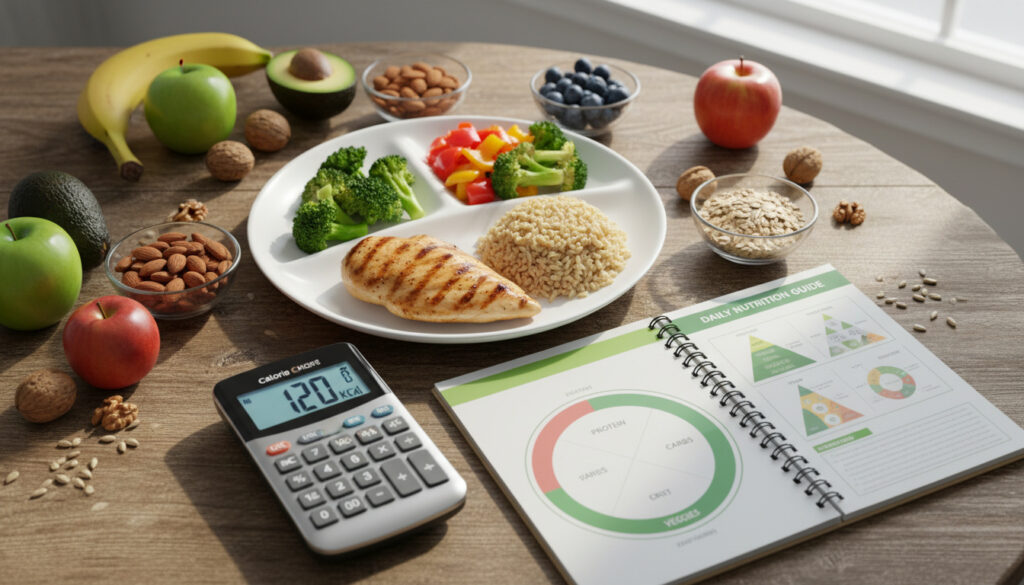
How Many Calories Should I Eat – Precise Daily Needs Guide
Determining daily calorie requirements involves understanding how your body consumes energy at rest and during activity. While general guidelines suggest standard amounts for adult men and women, individual needs vary significantly based on metabolic rate, physical demands, and physiological composition.
The foundation of these calculations rests on two key metrics: Basal Metabolic Rate (BMR), which measures calories burned during complete rest, and Total Daily Energy Expenditure (TDEE), which adjusts BMR for activity level. Accurate assessment requires applying specific formulas that account for age, height, weight, and gender to establish maintenance levels before adjusting for weight goals.
This guide examines the established methods for calculating these needs, the scientific basis for safe weight loss targets, and the physiological factors that create variation between individuals.
How Many Calories Should I Eat Per Day?
Average calorie needs differ substantially based on biological sex and activity patterns. Men typically maintain weight consuming 2,500 to 2,800 calories daily with moderate activity, while women generally require 1,600 to 2,000 calories for similar activity levels. These figures represent maintenance calories; weight modification requires strategic adjustment.
| Men (Average Maintenance) | Women (Average Maintenance) | Lose 1 lb/Week | Sedentary vs. Active Multiplier |
|---|---|---|---|
| 2,500–2,800 kcal/day | 1,600–2,000 kcal/day | TDEE minus 500 kcal | 1.2x vs. 1.9x BMR |
- The Mifflin-St Jeor equation delivers the most accurate BMR estimates across diverse populations.
- A daily 500-calorie deficit typically produces approximately one pound of weight loss per week through a 3,500-calorie weekly deficit.
- Activity level multipliers create the widest variation in final TDEE calculations, ranging from 1.2 for sedentary individuals to 1.9 for highly active athletes.
- Men generally require 400 to 800 more calories daily than women of comparable age and weight due to greater lean muscle mass.
- Regular recalculation becomes necessary after every 10-pound weight change to maintain accuracy.
- Caloric deficits exceeding 35 percent of TDEE risk metabolic adaptation, nutrient deficiencies, and unsustainable adherence.
- Online calculators automate these formulas but require honest assessment of activity levels to prevent overestimation.
| Gender | Age | Activity Level | Estimated Daily Calories |
|---|---|---|---|
| Male | 22 years | Moderate (1.55x) | 2,734 kcal |
| Male | 22 years | Sedentary (1.2x) | 2,117 kcal |
| Male | 43 years | Light (1.375x) | 2,384 kcal |
| Female | 21 years | Light (1.375x) | 1,896 kcal |
| Female | 21 years | Sedentary (1.2x) | 1,655 kcal |
| Male | 30 years (avg) | Moderate (1.55x) | 2,821 kcal |
| Female | 30 years (avg) | Light (1.375x) | 1,654 kcal |
| Male | 50 years | Very Active (1.725x) | 3,043 kcal |
How Do I Calculate My Daily Calorie Needs?
Calculating precise calorie requirements involves two sequential steps: determining BMR through validated equations, then applying activity multipliers to establish TDEE. Researchers consider the Mifflin-St Jeor formula most accurate for general populations, though alternatives exist for specific body compositions.
Basal Metabolic Rate Formulas
BMR represents the calories your body requires for basic organ function without movement. The Mifflin-St Jeor equation for men calculates BMR as 10 times weight in kilograms plus 6.25 times height in centimeters minus 5 times age plus 5. For women, the formula substitutes the final constant with minus 161. Pearson’s calorie deficit calculator demonstrates that a 22-year-old male weighing 75 kilograms and standing 180 centimeters tall burns approximately 1,764 calories at rest.
Alternative formulas include the Harris-Benedict Revised equation and the Katch-McArdle method, which incorporates lean body mass rather than total weight. The Harris-Benedict formula for men uses 66 plus 6.23 times weight in pounds plus 12.7 times height in inches minus 6.8 times age. Chomps nutrition resources confirm this yields 1,734 calories for a 43-year-old male weighing 170 pounds.
From BMR to TDEE
Total Daily Energy Expenditure emerges from multiplying BMR by activity coefficients. Sedentary individuals multiply by 1.2, while those exercising one to three days weekly use 1.375. Moderate activity levels (three to five days) require 1.55, very active individuals (six to seven days) use 1.725, and athletes or manual laborers apply 1.9. The National Academy of Sports Medicine calculator and Nerd Fitness guides both employ these standard multipliers.
Research indicates the Mifflin-St Jeor equation predicts BMR within 10% accuracy for most healthy adults, making it superior to older formulas like original Harris-Benedict. PTPioneer’s TDEE resources recommend this method for initial assessments unless body fat percentage is known precisely.
How Many Calories Should I Eat to Lose Weight?
Sustainable weight loss requires creating a controlled caloric deficit below TDEE without triggering metabolic slowdown or nutritional inadequacy. The standard recommendation involves reducing daily intake by 500 calories to achieve one pound of weekly loss, though individual responses vary based on starting weight and hormonal factors.
Safe Deficit Thresholds
Clinical guidelines suggest limiting deficits to no more than 35% of calculated TDEE to preserve lean muscle mass and metabolic health. For an individual with 2,500-calorie maintenance needs, this translates to a minimum intake of 1,625 calories daily. More aggressive approaches requiring 750 to 1,000-calorie daily deficits may suit larger individuals initially but require medical supervision.
Maintenance and Weight Stability
Achieving weight maintenance requires matching caloric intake precisely to TDEE calculations. As body mass decreases, BMR drops accordingly, necessitating periodic recalculation every four to six weeks or following every 10-pound reduction. TDEE Calculator.net and Calculator.net’s BMR tools provide automated recalculation functions for tracking these changes.
Deficits exceeding 35 percent of total daily energy expenditure may trigger metabolic adaptation, resulting in decreased thyroid function, reduced spontaneous physical activity, and difficulty sustaining weight loss long-term.
What Factors Affect My Calorie Intake?
Multiple physiological variables influence individual caloric requirements beyond simple age and gender classifications. Understanding these elements explains why standardized recommendations frequently fail to predict personal needs accurately.
Gender and Age Variations
Men typically exhibit higher BMR values due to greater lean muscle mass and larger organ size, often requiring 400 to 800 additional calories daily compared to women of similar age and height. Aging reduces BMR by approximately 2% to 3% per decade through sarcopenia and hormonal shifts. Women experiencing hormonal transitions may require adjusted calculations. How Long Does Menopause Last provides context for understanding these metabolic transitions.
Activity Level and Body Composition
Physical activity accounts for the largest variable in energy expenditure, ranging from 200 to 1,000+ additional calories daily. However, body composition significantly impacts calculations; individuals with higher muscle percentages burn more calories at rest. The Katch-McArdle formula specifically addresses this by incorporating lean body mass: BMR equals 370 plus 21.6 times lean mass in kilograms.
Thyroid disorders, polycystic ovary syndrome, and medications affecting metabolism may alter actual caloric needs significantly below or above calculated estimates. Iron Brothers’ calculator resources note that such conditions require professional medical assessment rather than formulaic approaches.
How Should I Adjust My Calorie Intake Over Time?
Effective calorie management requires systematic tracking and periodic adjustment rather than static adherence to initial calculations. The following protocol establishes evidence-based checkpoints for modifying intake.
- Establish Baseline: Calculate initial TDEE using current weight, height, age, and honest activity assessment.
- Implement Targets: Consume calculated maintenance or deficit calories consistently for 14 days without compensatory adjustments.
- Monitor Weight Trends: Record daily morning weight after bathroom use, calculating weekly averages to smooth normal fluctuations.
- Adjust Based on Data: If weight change differs from expected by more than 0.5 pounds weekly, modify intake by 100 to 200 calories and reassess.
- Recalculate Formally: Rerun complete BMR/TDEE calculations after every 10-pound weight change or significant alteration in exercise routine.
What Is Established vs. Uncertain About Calorie Calculations?
| Established Information | Uncertain or Individual Factors |
|---|---|
| BMR formulas predict resting metabolic rate within 10% for healthy populations | Specific gut microbiome effects on energy extraction from food |
| 3,500-calorie deficit produces approximately one pound weight loss initially | Adaptive thermogenesis rates vary significantly between individuals |
| Activity multipliers range 1.2 to 1.9 based on exercise frequency | Non-exercise activity thermogenesis (NEAT) changes under calorie restriction |
| Protein requires 20-30% of its calories for digestion versus 5-10% for fats | Long-term metabolic adaptation magnitude in reduced-obese individuals |
| Women require fewer calories than men primarily due to lower lean mass | Hormonal contraception effects on individual BMR |
Why Do Calorie Needs Differ Between Individuals?
Biological variation in energy expenditure stems from organ size differences, mitochondrial efficiency, and sympathetic nervous system activity. Two individuals identical in height, weight, and age may display BMR variations of 300 to 500 calories due to organ mass distribution, with the brain, liver, heart, and kidneys consuming disproportionate energy relative to their size.
Evolutionary adaptations further complicate standardization. Populations historically facing food scarcity developed thriftier metabolisms, while those in stable environments demonstrate higher caloric ceilings. How Long Do Rabbits Live illustrates how biological timelines and metabolic rates vary dramatically across species, paralleling the individual variation observed within human populations.
What Do Nutrition Authorities Say About Calorie Guidelines?
Professional organizations emphasize that mathematical formulas provide estimates rather than exact prescriptions. The precision of these calculations depends heavily on accurate self-reporting of activity levels, which research consistently shows people overestimate by 30% to 50%.
“TDEE is just an estimate. Start there, track your weight for 2-3 weeks, and adjust as needed. The math gets you in the ballpark; your body’s response determines the actual number.”
— Nutritional analysis from Nerd Fitness
“For weight loss, subtract 500 kcal/day from TDEE. Test accuracy by tracking weight. Limit aggressive loss to less than 35% TDEE deficit.”
— Clinical guidelines referenced by Pearson Health Calculators
What Are the Key Takeaways for Managing Daily Calories?
Accurate calorie management requires calculating BMR using the Mifflin-St Jeor method, applying appropriate activity multipliers to establish TDEE, and adjusting intake by 500 calories daily for weight loss while avoiding deficits exceeding 35% of maintenance needs. Regular recalculation every 10 pounds of weight change ensures continued accuracy as metabolic requirements shift with body composition.
Common Questions About Calorie Requirements
How accurate are online calorie calculators?
Online calculators using Mifflin-St Jeor or Harris-Benedict formulas typically predict BMR within 10% of measured values. However, accuracy depends entirely on honest inputs for weight, height, and especially activity levels, which users commonly overestimate.
What if I have a medical condition affecting metabolism?
Conditions like hypothyroidism, PCOS, or Cushing’s syndrome significantly alter caloric needs. Standard formulas may underestimate or overestimate requirements by 15% to 25%. Consult endocrinologists for medically supervised calculations.
How do I adjust calories for unplanned exercise?
Avoid eating back exercise calories automatically, as fitness trackers overestimate burn by 20% to 93%. Instead, use TDEE multipliers that already include your typical weekly exercise frequency.
Why do men need more calories than women?
Men typically possess greater lean muscle mass and larger organ size, increasing BMR by 5% to 10%. Testosterone also supports higher muscle maintenance costs, creating a 400 to 800 calorie daily difference versus women of similar age.
Is the 3,500 calorie rule for weight loss always accurate?
The 3,500-calorie-per-pound rule provides useful initial estimates but becomes less accurate as weight decreases. Metabolic adaptation and water retention variations mean actual loss may range from 0.5 to 1.5 pounds per 3,500-calorie deficit over time.
How often should I recalculate my TDEE?
Recalculate after every 10 pounds of weight change, significant shifts in body composition, or changes in daily activity lasting longer than two weeks. Monthly recalculation prevents plateaus from outdated metabolic estimates.
Can I use the same calorie target every day?
Daily consistency simplifies tracking, but weekly averages matter most for results. Some protocols use calorie cycling, maintaining the same weekly deficit while varying daily intake by 200 to 300 calories based on training schedules.
More related posts
 Best Mattress Topper UK – Expert Reviews and Buying Guide
 Royal Mail Fee to Pay Who Is the Sender – Scam Check and Safe Verification
 Scotland World Cup Draw – Group C with Brazil, Morocco, Haiti
 David Thewlis Movies and TV Shows – Complete Career Guide
 What Date Is Mother’s Day 2025 – Sunday May 11 US Facts
 Where Is The Traitors Filmed – Ardross Castle Location Guide 2025
 What’s the Difference Between Alzheimer’s and Dementia – Symptoms, Stages, Causes
 Take That Circus Tour – Dates Venues and Facts
